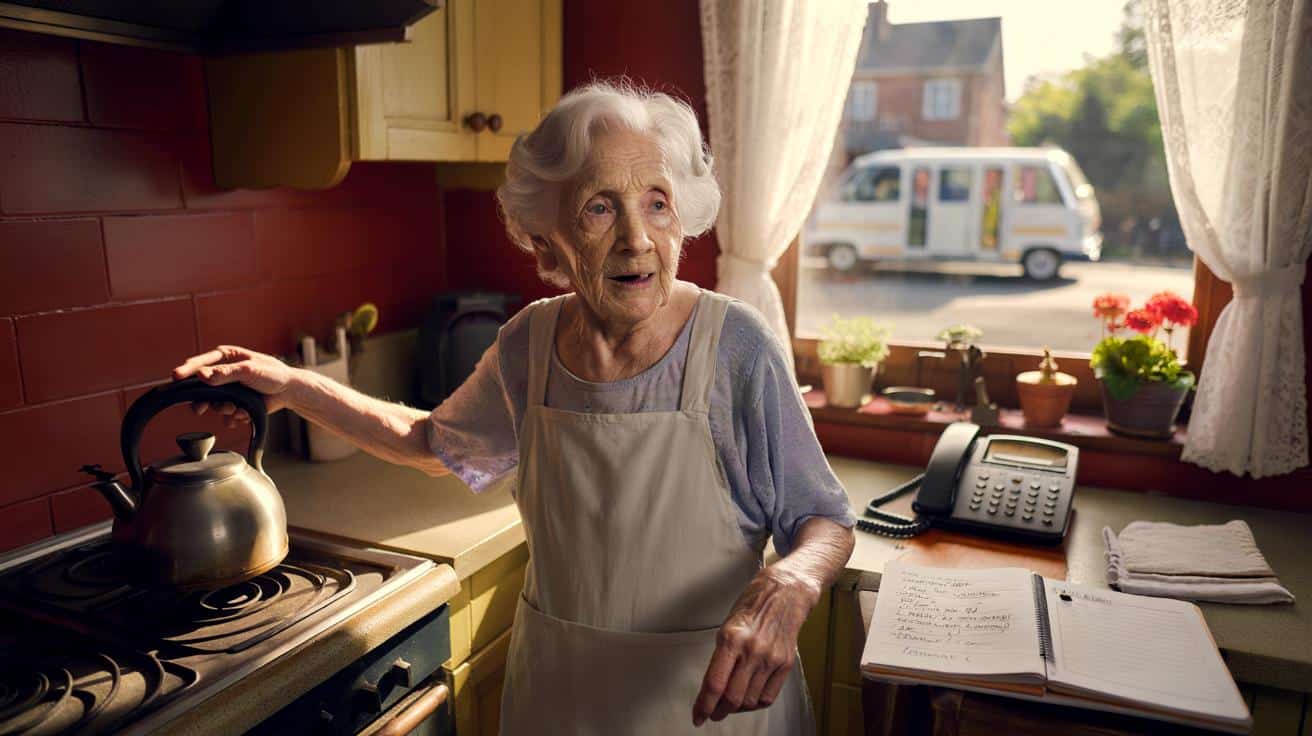
The kettle whistles in the small, sunlit kitchen, and she waves away her grandson’s hand as he reaches for the heavy cast-iron teapot. “I’m not porcelain,” she grumbles, standing up herself, back a little curved but steps surprisingly firm. Outside, the care home minibus pulls into the street, doing its daily rounds. She glances at it through the lace curtains with polite disdain. The neighbours say she should “think about assisted living”. Her doctor raised an eyebrow at her last blood test, not quite understanding how someone born in 1924 still climbs the stairs twice a day.
When you ask her how she does it, she doesn’t mention kale, yoga or intermittent fasting.
She talks about something else entirely. Something more unsettling, and oddly simple.
The centenarian who keeps saying no
Her name is Margaret, and at 100 she still lives alone in the same red-brick house where she raised two children and buried one husband. The carpets are older than many of her neighbours, and the television is permanently tuned to the news, volume a little too loud. She cooks her own porridge. She folds her own laundry. She waters the geraniums on the windowsill.
Every few months, a social worker gently suggests a care home brochure. Margaret smiles, nods, then leaves the pamphlet under a wobbly table leg. Her “no” is polite, but it’s firm. There is one routine she refuses to give up, and she swears this habit matters more than what she eats.
She calls it “having a reason”. At 8:30 every morning, she sits by the telephone and waits for it to ring. On Mondays, it’s her grandson on his way to work. Wednesdays, the neighbour from across the road who brings gossip and fresh eggs. Fridays, a woman she met in 1979 at a church raffle, now living three towns away.
They don’t talk long. Five minutes, ten at most. But the ritual is sacred. “If the phone stops ringing,” she says, “I’ll go.” By “go”, she doesn’t just mean the care home. You can hear the bigger fear behind it. Losing the thread that ties her to other humans.
Researchers now describe what Margaret lives every day. They call it “purpose”, “social connection”, “ikigai” in Japan. Blue Zone studies link it to longer life expectancy, lower risk of dementia, less depression. In one study from Brigham Young University, chronic loneliness increased the risk of early death as much as smoking 15 cigarettes a day.
Margaret doesn’t care about the statistics. For her, the habit is simple: one small, predictable moment when someone needs her to pick up. Not to be washed or monitored, but to be heard. That daily expectation pulls her out of bed, makes her brush her hair, keeps her in the world. The care home offers safety. Her tiny ritual offers meaning.
The habit she credits most – and how it actually works
When pressed, Margaret phrases it bluntly: “I make myself stay in people’s lives.” She doesn’t wait for visits to magically happen. She keeps a notepad by the phone with names, days, and small details she doesn’t want to forget. “Ask Claire about her exam.” “Check on Joan’s hip.”
➡️ The “taxi smell” method: why fabric holds odor and how pros neutralize it
➡️ The subtle difference between feeling busy and feeling mentally engaged
➡️ Visible floor edges enlarge perceived space
➡️ The reason familiar sounds feel grounding during uncertainty
➡️ Why some people feel refreshed after routine days
➡️ Home wind turbines fail without consistent laminar flow
➡️ Beekeeper land tax dispute: the weird definition that turns “helping” into “income”
➡️ “White hydrogen” sounds clean and infinite, but geologists say extraction is the real unknown
Once a week, she writes one letter by hand. Just one. Sometimes it’s a proper letter, sometimes a postcard with three clumsy sentences and a wobbly signature. The handwriting is shaky, the ink sometimes smudged, *but it arrives*. That’s her habit: a deliberate act of reaching out, even when the world feels faster and louder than she is.
Most of us assume long life is won in the supermarket aisle or the gym. Margaret quietly contradicts that. Her diet is fine but not saintly: toast, tea, a biscuit more often than doctors would like. She tried Pilates on TV once and called it “a bit silly”. Yet she invests serious energy in remembering birthdays, sending small cards, calling people when their name pops into her head.
On a shelf near the television, there’s a shoebox full of return letters and printed emails that someone else has put on paper for her. “I read one when I feel useless,” she admits. On a bad winter night, those envelopes function like central heating for the soul.
Psychologists would say she is actively resisting social erosion. Friends die, neighbours move, bodies slow down. The default setting at that age is isolation. Margaret’s habit pushes against that pull. One relationship at a time. One awkward phone call at a time.
What sounds small is, in reality, neurobiology at work. Social contact triggers oxytocin and dopamine, regulating stress and inflammation. The brain gets tiny but regular reminders: “You matter. Stay alert.” Her world hasn’t magically stayed wide; she’s just refused to let it shrink without a fight. *This* is the habit she credits more than any “perfect” breakfast: she cultivates reasons to be missed.
Stealing her habit (without waiting to be 100)
Margaret’s approach can be translated into something very practical: a “people routine”. Think of it as brushing your teeth, but for your sense of belonging. She has specific days for specific people. You could do the same with a simple weekly grid on your fridge or phone.
Pick three to five names. Not just your favourites, but also the quiet friend, the slightly grumpy uncle, the colleague who moved away. Assign each one a small slot: a message on Tuesday, a call on Thursday, a voice note on Sunday. Nothing long, nothing polished. Just contact that exists on purpose, not by accident.
On paper it looks easy. In real life it bumps into all the usual things: tired evenings, social anxiety, the “I’ll do it tomorrow” trap. Soyons honnêtes : personne ne fait vraiment ça tous les jours. Margaret doesn’t either. She has off days, naps that last too long, winters where she barely leaves the sofa.
The difference is that she always comes back to it. She treats her habit like a slightly leaky boat she keeps patching. Missed a week? She writes “I disappeared, but I’m back” on her next postcard. No drama, no guilt spiral. That gentle permission to be imperfect keeps the whole thing going in the long run.
“When they ring, I’m not old,” Margaret tells me at one point, almost whispering. “I’m just Margaret again.” Her eyes water, though she blames the draft. Then she laughs at herself and adds, “I like being expected.”
“Long life isn’t just surviving,” she says. “It’s being awaited.”
From a health perspective, that tiny sentence is huge. Being awaited is an antidote to invisibility. It reduces the quiet, corrosive belief that the world would be exactly the same if you weren’t in it. Here’s a simple way to borrow that power:
- Set one small “I’m expecting you” ritual a week: coffee with a neighbour, a standing Thursday call, or a shared walk. Keep it modest, repeatable and slightly sacred.
- Start a low-pressure “one message a day” rule: a photo, a silly meme, a short voice note. Quantity is less crucial than consistency.
- Create a tiny “I matter” archive: screenshots of kind messages, printed emails, birthday cards. On lonely days, open it like a medicine cabinet.
A different kind of longevity story
There’s something quietly radical in the way Margaret refuses the narrative laid out for her age. The care home brochures talk about safety, meals, fall alarms. All useful, all necessary for many. She doesn’t dismiss any of that. She just fears becoming “someone on a list” more than she fears the stairs.
Her habit – that stubborn maintenance of human ties – is a form of resistance. Against ageism. Against the idea that after 80, your role is to be managed rather than wanted. We all say we’re “too busy” for this kind of deliberate connection, yet she does it from an armchair with limited mobility and a landline that sometimes crackles.
On a deeper level, her story scratches at something we rarely admit out loud: the terror of becoming irrelevant. On a bad day, many of us scroll through social media, counting likes like proof of existence. Margaret’s proof is slower and older. A knock at the door. A phone that still rings. A birthday card written in blue ink.
On a quiet Tuesday afternoon, she shows me a bent photograph of a family Christmas in the 1960s. “They all think I’m the miracle for reaching 100,” she says. “I’m not. I just didn’t let go of people.” Her sentence hangs in the room, heavier than the ticking clock. It’s not a recipe. It’s an invitation.
The thought lingers as you step back into a world of notifications and quick messages. How many of your current connections would survive if the algorithm vanished? Who would still ring on purpose, not out of habit or obligation? And whose phone would you want to keep ringing, decades from now, simply so they never feel like they’ve slipped off the map?
Without planning it, Margaret forces us into an uncomfortable question: if longevity is partly about feeling awaited, what are we doing today that makes tomorrow worth reaching? The answer probably won’t be found on a food label. It might start with a name, a time in your calendar, and a call that feels slightly awkward at first — until it doesn’t.
| Point clé | Détail | Intérêt pour le lecteur |
|---|---|---|
| La connexion avant le régime | Margaret attribue sa longévité à ses liens sociaux réguliers, pas à une alimentation parfaite. | Recentrer ses efforts de “santé” sur quelque chose de faisable dès maintenant, sans changer tout son frigo. |
| Une routine de personnes | Elle a des créneaux précis pour différents proches, comme un calendrier affectif. | Offre un modèle concret pour sortir de la solitude ou de l’isolement discret. |
| Être attendu, pas seulement protégé | Sa plus grande peur est de ne plus être attendue, davantage que la dépendance physique. | Inviter à créer des rituels où l’on compte vraiment, au-delà des likes ou des visites ponctuelles. |
FAQ :
- Is social connection really more powerful than diet for long life?Studies suggest strong social ties can rival or exceed classic risk factors like smoking or obesity for mortality, especially in older adults. Diet matters, but connection shapes whether people actually want to keep going.
- What if I’m introverted or hate the phone?You don’t need constant chatter. One or two deep, predictable contacts can be enough: a weekly text thread, a shared walk, a book club with just two people.
- How can younger people apply Margaret’s habit?Create small, recurring rituals with people you care about: a fixed call with a parent, a monthly dinner with the same friend, a rotating Sunday walk. Make it simple enough to survive busy weeks.
- What about older relatives who resist assisted living?Instead of only arguing about safety, explore what they fear losing: autonomy, routine, specific relationships. Sometimes strengthening those threads can make any transition softer.
- Is it ever “too late” to build this kind of network?No. Even a single new consistent connection — a neighbour, a community group, an online club — can shift how the future feels. The habit starts with the next call, not the perfect life story.