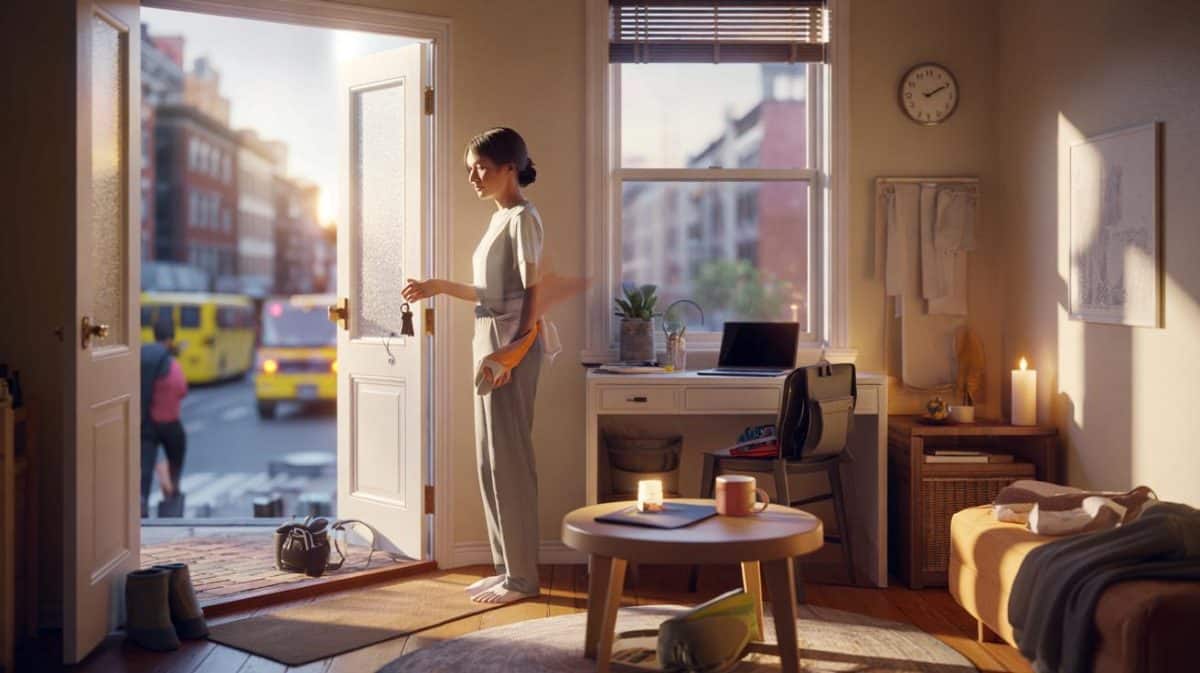
The living room looked fine on paper.
Same square metres as the flat next door, same ceiling height, same rectangular box. Yet when the estate agent opened the door, something strange happened: this one felt bigger. No new windows, no mirrored wall tricks, no clever staging with fake plants. Just one clear difference. You could see the entire outline of the floor in one glance. Every edge, every corner, every line between wall and ground was visible, clean and uninterrupted. The space hadn’t changed, but your brain swore it had. That tiny visual shift does something quietly radical.
Why visible floor edges change how big a room feels
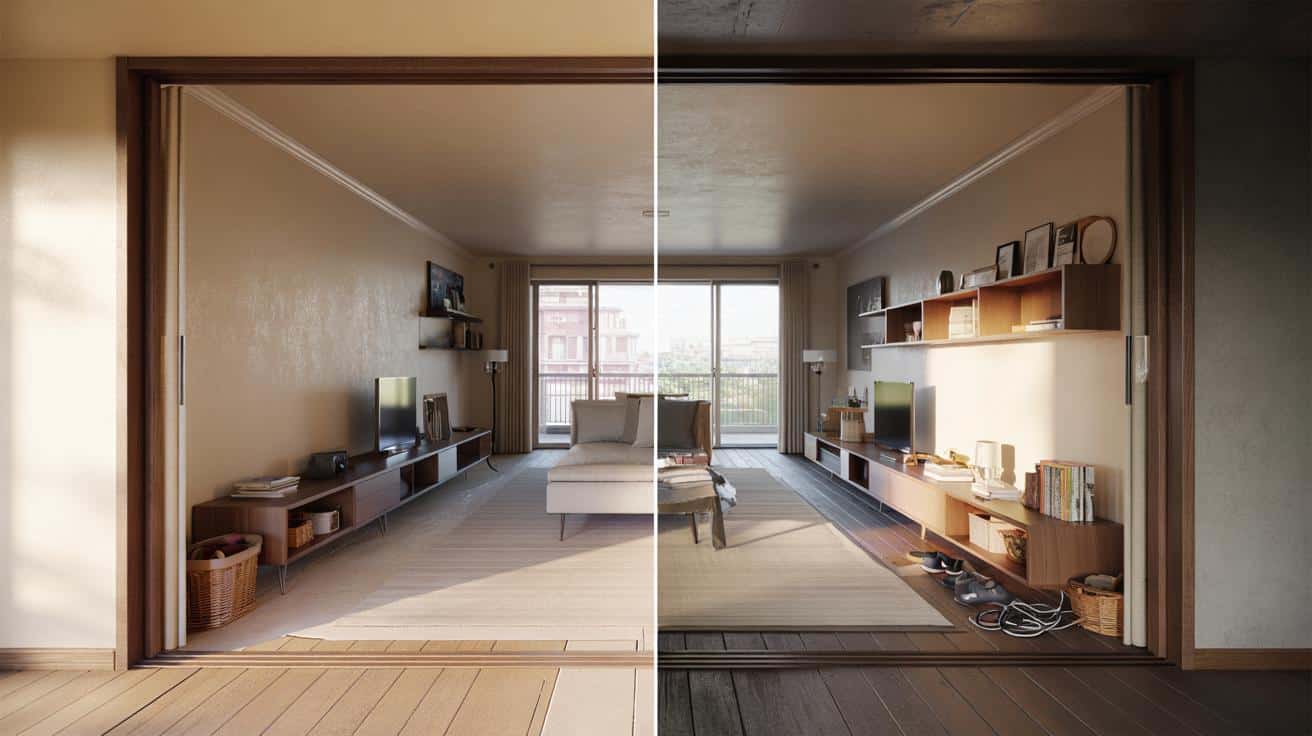
The first time you notice it, you can’t unsee it. Walk into a room where furniture floats away from the walls, the skirting boards are visible, and the floor runs like a single continuous surface. The space suddenly feels looser, more generous. Your eyes travel all the way to the edges, then rest there for a second. That pause matters. It’s the moment your brain registers: “There’s more room here than I thought.”
Now compare that with a room where every wall is lined with bulky storage, low sofas, overflowing baskets. The floor edges are hidden under sofas, boxes, cables, shoes. You only see a cluttered island in the middle. The same number of square metres, but your field of view shrinks to a crowded centre. The message your brain receives is totally different: “This place is small. Tight. Busy.” Visible floor edges don’t change the layout. They change the story your eyes tell you.
Interior designers talk about “breathing room”, but what they rarely spell out is how literal it is. When you can trace the contour of the floor in one simple sweep, the room reads as one single volume. No broken lines. No visual interruptions. Our brains are lazy in a smart way: they judge size by what they can map quickly. Clear floor edges act like underlining in a text. They outline the real boundaries of the space, and your perception inflates to match them.
Practical ways to reveal those precious floor edges
If you want a room to feel bigger tomorrow morning, start at ankle level, not eye level. Step back and look only at the contact line where wall meets floor. That thin band tells you everything. Can you see it all the way around the room, or is it hidden behind furniture, shoes, radiators, boxes, and laundry baskets that never made it back to their cupboard?
The quickest win is this: pull big pieces of furniture just a hand’s width away from the wall, then clear what’s at their feet. That tiny shadow line behind a sofa or sideboard reveals more floor edge, and suddenly the wall looks further back. If you live in a small flat, that illusion is gold. Sliding a bed 10 cm off the wall and clearing the floor under it can feel almost ridiculous. Then you step back and the room suddenly exhales.
Most people start by decluttering the middle of the room. The coffee table, the chair pile, the endless tote bags. That helps a bit, but the real magic is near the walls. You want to think like a photographer framing a shot: what lines are visible in the picture? If the only visible floor is in the centre, your “frame” is tiny. Clear just 10–15 cm along each wall and your mind redraws the outline of the whole room. *The geometry hasn’t changed, only the way your brain reads it.*
Common mistakes and small fixes that change everything
The easiest method is almost embarrassingly simple: do a “perimeter walk”. Start at the door and follow the wall with your eyes, not your feet. Each time the floor edge disappears behind something, ask yourself one question: could this live 5 cm higher, narrower, or elsewhere? Wall hooks instead of a floor coat stand. A slim shoe rack instead of a jumble by the door. A floating TV unit instead of a heavy cabinet sinking into the skirting board.
We tend to push everything up against the walls, thinking we’re “freeing the centre”. It feels logical. In practice, it creates a ring of visual noise and hides the exact lines that make your room feel larger. On a bad day, that ring turns into a moat of stuff you have to navigate. On a good day, you still lose the chance to see the full footprint of the floor. Soyons honnêtes : personne ne fait vraiment ça tous les jours. You fix it once, then you protect it with habits that are small enough not to hurt.
The big trap is storage overload. Tall bookcases, chunky wardrobes, stacked boxes right down to the floor – they swallow the skirting line, and with it, your sense of volume. Designers often leave at least a hint of floor visible under or beside large pieces, even if it means losing a shelf. That “wasted” gap pays you back in perceived space every single day. Sometimes the bravest choice is to own less furniture and let a wall breathe for no other reason than: it makes the room feel like it grew.
➡️ Why some people feel refreshed after routine days
➡️ Beekeeper land tax dispute: the weird definition that turns “helping” into “income”
➡️ How “record fish” are verified: what counts as proof beyond a photo and a tape measure
➡️ The subtle difference between feeling busy and feeling mentally engaged
➡️ The centenarian who refuses assisted living: the habit she credits most (and it’s not diet)
➡️ The reason familiar sounds feel grounding during uncertainty
➡️ “White hydrogen” sounds clean and infinite, but geologists say extraction is the real unknown
➡️ Home wind turbines fail without consistent laminar flow
One designer I spoke to summed it up in a single line:
“I don’t sell square metres, I sell how big a place feels when you stand in it.”
That’s exactly what visible floor edges do for you. They don’t change the maths. They change the feeling.
- Lift, don’t sprawl – Prefer furniture on legs to bulky pieces that sit flat on the floor.
- Protect the “floor frame” – Keep 10–15 cm clear along each wall as a visual border.
- Use light and contrast – A slightly lighter floor or skirting helps edges pop without looking harsh.
Living with space that feels larger than it is
Once you’ve seen what exposed floor edges do, every room becomes a quiet experiment. You slide a chest of drawers 5 cm to the left, clear the shoes from underneath, and suddenly the corner looks like it has depth again. You swap a heavy rug that stops mid-room for one that reaches closer to the walls, and strangely, the room doesn’t feel weighed down but more unified. Your eyes stop tripping over abrupt endings and start gliding to the edges.
On a tired evening, when everything feels a bit cramped and noisy, that extra sense of openness can be more than a visual trick. The room feels kinder, less on top of you. We’ve all had that moment where the flat feels as if it’s closing in, and you don’t know why. Often it’s not the size. It’s the way objects have crept up around the invisible frame of the floor. You reclaim it, and the atmosphere shifts from “boxed in” to “I can breathe here”.
This is where the idea of home gets interesting. When visible floor edges enlarge perceived space, you’re not just hacking your brain. You’re re-negotiating the relationship between your stuff and your freedom. *A few centimetres of exposed floor can feel like a quiet act of resistance against cramped living.* It’s not magic; it’s line, light, and a bit of stubborn attention. And it stays with you. Next time you enter any room – a hotel, an office, a friend’s kitchen – you’ll catch yourself glancing down, tracing that thin outline that tells you how big the space feels, even before you’ve crossed the threshold.
| Point clé | Détail | Intérêt pour le lecteur |
|---|---|---|
| Révéler le “cadre” du sol | Rendre visibles les bords du sol sur tout le périmètre de la pièce | Donner instantanément l’impression d’un espace plus grand sans travaux |
| Alléger le mobilier au sol | Choisir des meubles sur pieds et libérer quelques centimètres le long des murs | Augmenter la profondeur perçue et la clarté visuelle |
| Protéger le périmètre au quotidien | Éviter l’accumulation d’objets et de rangements posés à même le sol | Préserver la sensation d’espace et de respiration dans les petites surfaces |
FAQ :
- Do visible floor edges really make a measurable difference?Not in raw square metres, but in how your brain interprets them. Studies on visual perception show that continuous lines and clear boundaries expand perceived size.
- Is this trick useful in very small studios?Yes, especially there. Even a 10 cm clear strip around the walls can make a cramped studio feel less like a box and more like a room.
- What if I can’t change my furniture?Focus on what touches the floor: clear cables, baskets, shoes and bags along the walls. Sometimes removing three small floor-level items does more than changing a sofa.
- Do rugs help or hurt perceived space?Rugs that stop abruptly in the middle of the room can shrink it visually. Larger rugs that reach closer to the walls, or rugs with a border, tend to support the sense of a unified, bigger floor.
- How often should I “reset” the floor edges?A quick monthly sweep around the perimeter is usually enough. Think of it as checking that the invisible frame of your room is still visible to your eyes.