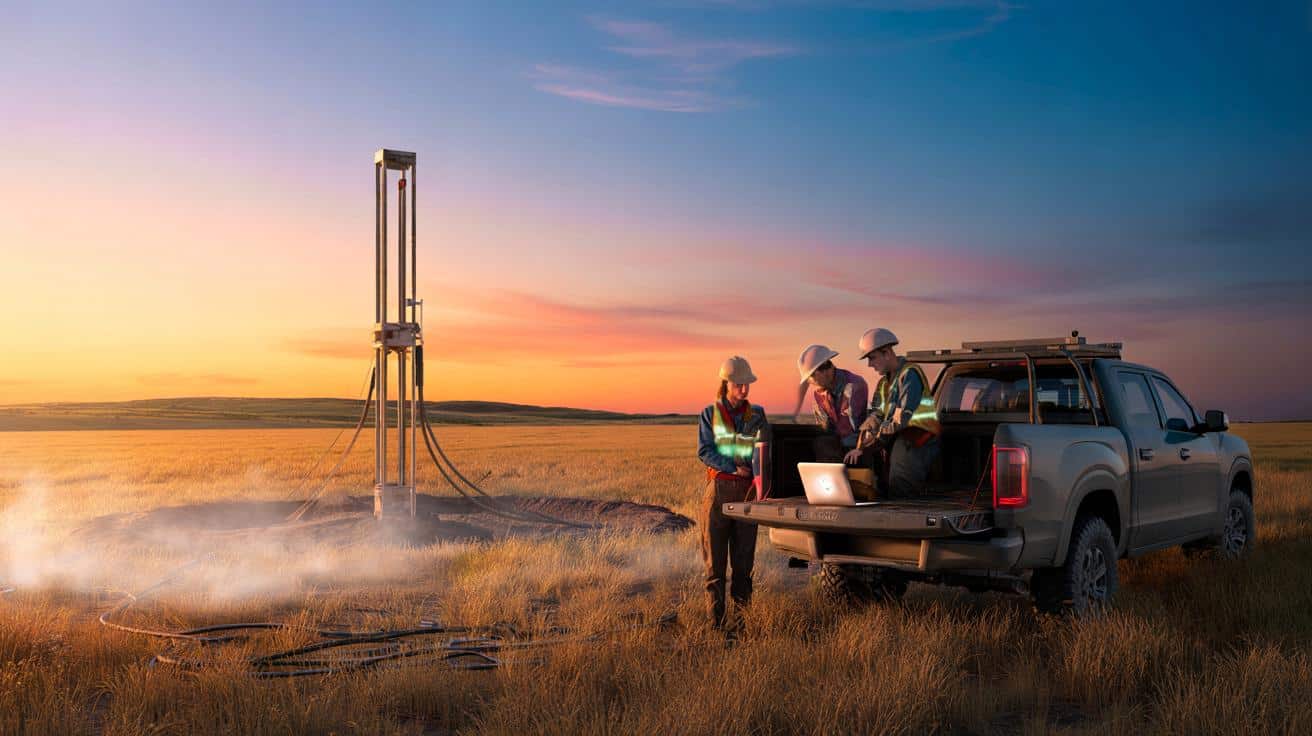
The pickup stops at the end of a dusty track in rural Nebraska.
Over the fields, wheat shimmers in the late afternoon light, and at the far edge, a group of geologists stand in a loose circle, staring at a laptop perched on the back of the truck. On the screen, a jagged line spikes where no one expected it. Someone swears softly. If the data is right, there’s hydrogen seeping up from deep underground, invisible and odourless, like a quiet promise. A “gold rush without the guilt”, one of them jokes.
They all know that’s not quite true. The maps are rough. The models are young. The technology to get this so‑called “white hydrogen” out of the ground is, frankly, closer to a sketch than a blueprint. The air is still, but you can feel the tension. Something big might be hiding here.
White hydrogen: the clean dream underneath our feet
On paper, white hydrogen sounds like sci‑fi made real. Naturally occurring, potentially renewable, burning without CO₂, bubbling quietly in pockets and fractures under continents and ancient rocks. It’s being pitched as the clean cousin of oil and gas, waiting patiently for us to notice it. In a world scrambling to ditch fossil fuels, that kind of story spreads fast.
Early explorers talk about it with the same glow you hear in old clips of North Sea oil pioneers. There’s that same mix of uncertainty and swagger. Yet in the quiet moments, when microphones are off, some geologists whisper a different line: we don’t actually know how much is down there, or how to pull it out without breaking something we can’t fix. That’s the part the hype often skips.
Take Mali. In the village of Bourakébougou, a borehole drilled for water in the 1980s started releasing a strange gas. Locals used it to power a generator; only years later did scientists confirm it was almost pure hydrogen. That small plant has been running for years with barely any CO₂. It sounds like a miracle, almost like the planet left a hidden battery plugged in for us in the Sahel.
The story spread and caught the eye of start‑ups and energy majors. In France, tiny deposits in Lorraine. In the US, promising signals in the Midwest and Appalachia. Australia, Spain, Morocco, Brazil… each new hint pushes another speculative map into a slide deck for investors. Venture capital loves a clean narrative, and “infinite, natural hydrogen” feels tailor‑made for that. *The risk is that the stories move faster than the science.*
Strip the romance away and the geology is messy. Hydrogen is a tiny, slippery molecule. It leaks, reacts, disappears into minerals and fluids. It can be generated continuously in some rocks, like ultramafic formations where water and iron‑rich minerals react in a process called serpentinisation. It can also escape just as fast, drifting up through faults and fractures, lost to the atmosphere.
Finding stable accumulations is like hunting a moving target in 3D. The models we use for oil and gas don’t fully work, because hydrogen behaves differently in the subsurface. That’s why many geologists flinch when they hear the word “infinite”. The Earth may keep making it, yes, but whether we can tap it in a controlled, economic way is a completely different question. And that question is still half‑open.
Extraction: where the map turns blank
The straightforward pitch sounds like this: drill a well, capture the hydrogen, sell clean energy. Reality is less neat. There’s no universal “white hydrogen rig” yet. Most early wells are repurposed exploration tools, adapted from oil and gas techniques. Engineers are improvising, testing how hydrogen flows in different rocks, at different pressures, with different impurities like nitrogen or helium riding along.
Underground, the technical riddles pile up. Hydrogen can embrittle steel, so casing materials and wellheads need careful choices and new standards. Old gas infrastructure might not survive long exposure. Surface processing has to separate hydrogen from other gases without wasting the energy that makes the whole thing climate‑friendly. Each field could need its own recipe. That’s hard to scale.
➡️ The centenarian who refuses assisted living: the habit she credits most (and it’s not diet)
➡️ Why some people feel refreshed after routine days
➡️ The reason familiar sounds feel grounding during uncertainty
➡️ Visible floor edges enlarge perceived space
➡️ The “taxi smell” method: why fabric holds odor and how pros neutralize it
➡️ Home wind turbines fail without consistent laminar flow
➡️ Beekeeper land tax dispute: the weird definition that turns “helping” into “income”
➡️ How “record fish” are verified: what counts as proof beyond a photo and a tape measure
On top of that, no one fully understands the long‑term behaviour of a “white hydrogen field”. Will it recharge as rocks keep generating gas, like a slow, perpetual fountain? Or will pressure drop sharply after the first years of production? One French team compares it to drawing water from a spring you’ve never measured: you don’t know if you’re tapping an aquifer or just a puddle. Soyons honnêtes : personne ne fait vraiment ça tous les jours.
On the regulatory side, things are just as foggy. Most countries don’t have a legal category for natural hydrogen, so companies squeeze into old mining or gas frameworks. That affects everything: licence terms, royalties, environmental checks. Investors like certainty. Regulators like precedents. White hydrogen has neither.
One UK geologist joked that they were “doing Victorian science with 21st‑century spreadsheets”. The datasets are patchy, often from wells drilled for completely different reasons decades ago. Re‑interpreting them for hydrogen is creative work, but also risky. A single over‑optimistic press release can trigger a mini‑rush on exploration licences, long before communities nearby understand what’s being planned under their fields and forests.
Many readers imagine extraction as a clean tap in the ground feeding a silent pipeline. People living next to proposed sites see something else: rigs, trucks, seismic surveys, questions about groundwater, and memories of past battles over shale gas. On a bad day, white hydrogen can look like fracking in a new costume. On a good day, it could be a chance to do things differently, starting with how early locals are brought into the conversation.
How to read the hype without getting lost
If you want to make sense of the daily headlines, start by zooming in on three simple clues: the rocks, the scale, and the timeline. First, rocks. Any serious project should name the geology it’s targeting: old cratons, ultramafic rocks, rift basins, known fault systems. When a company talks only about “huge untapped potential” without a single stratigraphic or structural detail, that’s a red flag.
Next comes scale. Is the discovery a tiny seep, a modest field, or a basin‑wide play? Look for numbers: estimated volume in tonnes or cubic metres, not just phrases like “world‑class”. Finally, the timeline. Projects that mention pilot wells, test production, and specific partnerships with universities are usually grounded in reality. Vague “commercial production within three years” promises, with no interim steps, tend to age badly.
When you read about a new find, pause at any claim using “infinite”, “limitless” or “game‑changing”. Ask yourself who is speaking. A state geological survey, a public research lab, or a listed start‑up under pressure to keep its share price afloat? None of these are neutral, but they don’t carry the same incentives. On a smartphone screen, all quotes look equal. They’re not.
The other habit that helps: compare white hydrogen to things you already know. Oil took decades of trial, error and disaster to become “routine”. Offshore wind needed years of ugly prototypes before becoming sleek. It would be strange if a new subsurface industry somehow skipped that messy middle phase. On a human level, that’s where anxiety lives too. People who’ve watched boom‑and‑bust cycles up close learn to wait and see, even when the first drill hits pay dirt.
When geologists talk freely, their tone shifts from sales pitch to cautious curiosity.
“We might be staring at a new chapter in the energy story,” says one hydrogeologist in Lyon, “or we might just discover that natural hydrogen is a quirky geological footnote. Right now we’re somewhere in between, and that’s both exciting and slightly terrifying.”
Underneath the jargon, that’s the emotional core of this moment. On a planet over‑heating, *any* prospect of clean, abundant energy tugs at something deep and hopeful. On a personal scale, communities living on top of these rocks carry another feeling: the memory of being promised jobs and left with scars.
- Watch the language in announcements: bold adjectives with few numbers usually signal marketing, not measured science.
- Look for independent voices from public surveys or universities to balance company slides.
- Pay attention to who benefits locally, not just to who rings the bell on a stock exchange.
A future that depends on what we choose to ask
White hydrogen sits in a strange place between miracle and mirage. The chemistry checks out. The first real‑world examples, like Bourakébougou, prove it can be tapped and used. Some basins genuinely look promising in the models. Yet the gaps are just as real: foggy geology, untested extraction methods, missing rules, and a social licence that doesn’t exist yet. On a bad day, it feels like we’re trying to run before we know where the floor is.
On a good day, this uncertainty can be a gift. We’re early enough to ask different questions than we did with oil and gas. How much hydrogen do we truly need, rather than how much can we sell? Which ecosystems or aquifers are simply off‑limits, no matter the potential? What does genuine consent look like for rural towns who suddenly find themselves on someone else’s energy map?
On a more personal note, white hydrogen forces us to confront a quieter issue: our hunger for simple, heroic fixes. We love the idea of a clean fuel bubbling up just when we need it, like the planet apologising for the last century. Reality is less tidy. Geologists will keep arguing over data. Engineers will break tools and try again. Communities will push back, or lean in, or both. The real unknown isn’t just how much hydrogen waits underground. It’s whether we can learn to handle a new resource without repeating the same old story.
| Point clé | Détail | Intérêt pour le lecteur |
|---|---|---|
| Nature of white hydrogen | Naturally occurring, low‑carbon hydrogen generated in specific rock formations | Helps you understand why it’s being framed as a “clean” game‑changer |
| Extraction uncertainties | Unproven field behaviour, technical challenges, and limited real‑world projects | Gives context to bold claims and helps you spot hype |
| Social and regulatory questions | Patchy laws, local impacts, and ownership of subsurface resources | Shows how this could affect communities, politics and daily life |
FAQ :
- Is white hydrogen really “infinite”?Geologically, some rocks may keep producing hydrogen over time, but that doesn’t mean endless, easy supply. Physical limits, leakage and economics all cap what we can actually use.
- How is white hydrogen different from green hydrogen?White hydrogen is found naturally underground, while green hydrogen is made by splitting water with renewable electricity. One depends on geology, the other on power grids and electrolysers.
- Could white hydrogen replace fossil fuels completely?Unlikely on its own. At best, it could join a mix of renewables, storage and efficiency. We don’t yet know whether there are enough accessible resources to support global demand.
- Is extracting white hydrogen safer than fracking?Different process, similar worries. Drilling, subsurface pressure changes and surface infrastructure can raise concerns about water, noise and land use. Safety depends on how each project is designed and monitored.
- When might we see large‑scale white hydrogen projects?If early pilots go well, some regions could move towards commercial production in the 2030s. Genuine, global scale will take longer, and hinges on technology, regulation and public acceptance.