The photo hits the group chat at 06:14.
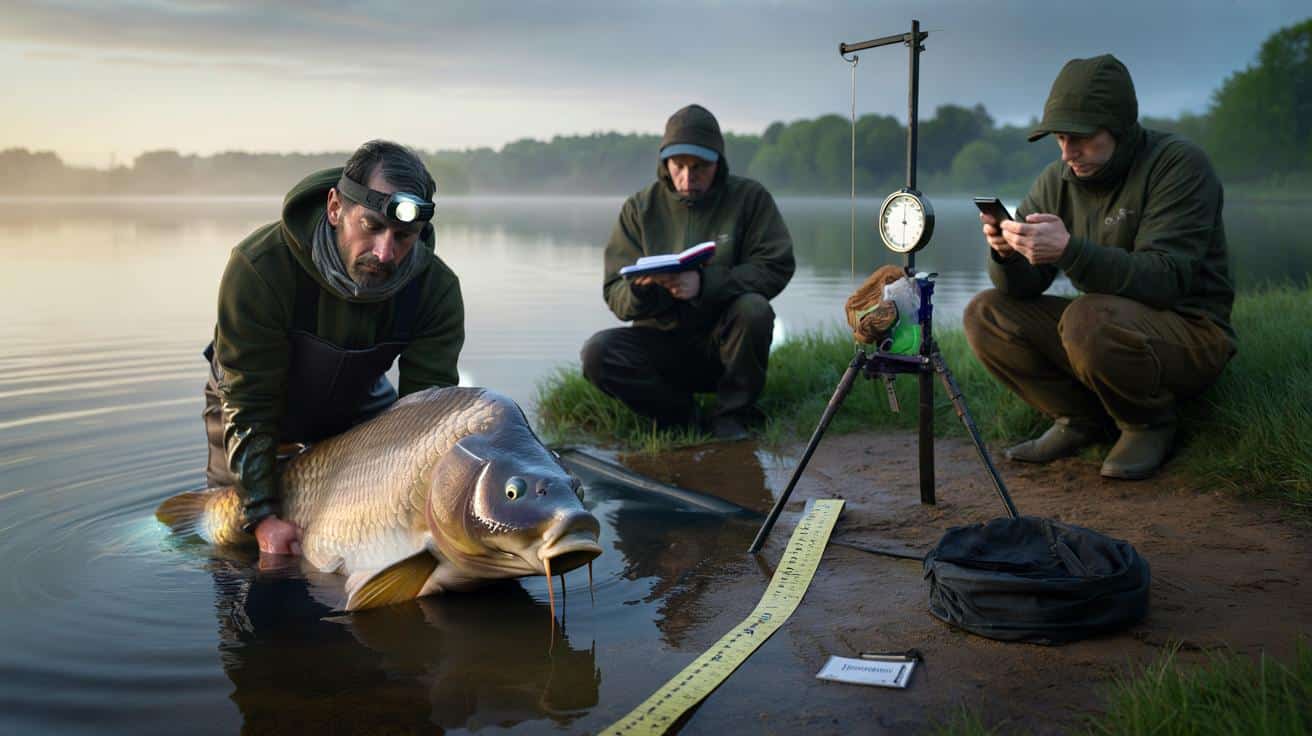
A bloke in a damp hoodie, headlamp still on, both arms locked around a carp so thick it looks unreal. Comments explode. “Mate that’s 50 easy.” “New lake record?” Someone zooms in on the tail. Someone else points at the tape measure in the mud and laughs. Then the big question drops: “Is it *official*?”
On watersides across the UK and far beyond, that question quietly stalks almost every “PB” photo. It’s one thing to claim a monster to your mates. It’s another to say the words “record fish” out loud, in public, where it can be checked, argued, even mocked.
Behind every name on a record list sits a strange mix of science, paperwork and old‑fashioned angling honour. A quick snap and a muddy tape just don’t cut it.
When a fish isn’t “just” a fish any more
The moment a fish looks *too* big, everything changes. Your pulse spikes, your hands shake, your brain flicks from “what a beauty” to “is this… something else?”. That’s where the invisible line lies between a proud personal best and a potential record. One belongs in your camera roll. The other might go down in history.
On the bank, though, things are messy. You’re cold, maybe on your own, head full of adrenaline. The fish is still pulsing in your hands. You feel torn between looking after it and grabbing every scrap of proof you can. That’s the tension at the heart of any “record” claim: the clash between raw excitement and clinical evidence.
Different countries and record bodies handle that clash in their own way. Some lean heavily on tradition and trust. Others bury you in forms, signatures and scale readings. Either way, a pattern emerges once you look closer. Records are less about the one huge fish, and more about a repeatable story that other people can check.
Beyond the hero shot: what “proof” really looks like
Think of a record claim like a crime scene. A single blurry CCTV still isn’t enough. You need multiple angles, a timeline, physical evidence and at least one reliable witness. With fish, that usually starts with weight, not length. Most official records are anchored to a certified scale reading, taken in a very specific way.
Organisations such as the International Game Fish Association (IGFA) or national angling bodies are borderline obsessive about this. Scales must be calibrated and traceable. Slings and nets have to be weighed separately. The reading must be clearly visible, ideally photographed from more than one side. If you weigh a fish three times and pick the highest number, you’re already in trouble.
Then there’s the tape measure. Length and girth shots aren’t just pretty extras. They help detect exaggerations and, in some cases, misidentifications. If your alleged 50lb barbel is oddly short and barrel‑shaped, record officers will start asking awkward questions. The numbers have to make biological sense, not only social media sense.
Stories of world records almost always feature that one friend who kept their head while everyone else lost it. A calm voice saying: “Hold on, we need to document this properly.” Without that person, a lot of legendary fish would have stayed pub stories. Not because the fish weren’t real, but because the evidence was flimsy.
➡️ The subtle difference between feeling busy and feeling mentally engaged
➡️ Why some people feel refreshed after routine days
➡️ Home wind turbines fail without consistent laminar flow
➡️ “White hydrogen” sounds clean and infinite, but geologists say extraction is the real unknown
➡️ The reason familiar sounds feel grounding during uncertainty
➡️ Visible floor edges enlarge perceived space
➡️ The centenarian who refuses assisted living: the habit she credits most (and it’s not diet)
➡️ Beekeeper land tax dispute: the weird definition that turns “helping” into “income”
One well‑known UK carp, claimed as an unofficial lake record a few years ago, illustrates the point. The fish itself was beyond doubt; many anglers had caught it before. Length and girth matched older captures. But the new “record” weight came from a cheap digital scale that had never been checked, with no witness close enough to read it. The claim sort of floated around, then quietly died.
Contrast that with long‑standing record salmon and pike. Their stories read like small investigations. Exact location noted. Tackle recorded. Weather written down. Weighing witnessed. Photos from before and after the reading. Sometimes even scale samples sent to biologists. The fish is the star, but the paperwork is the real engine behind its fame.
This is where modern tech both helps and complicates things. Time‑stamped phone photos and GPS data can back up a claim. At the same time, apps and filters make faking size and colour easier than ever. Record panels know that. So they lean on what can’t be easily edited: calibrated weights, consistent measurements, and people willing to sign their names to a written statement.
The unseen checklist: what record judges quietly look for
There’s a rough mental checklist any serious record officer runs the moment a claim lands on their desk. First, species. Is the fish exactly what the angler says it is? Hybrids, stocked strains or even escaped farm fish can disqualify a catch at a stroke. Close‑up photos of the head, fins and tail matter more here than the classic “arms‑out” brag shot.
Then origin. Was the fish caught from open, eligible waters or some heavily stocked commercial pond? Different lists have different rules. Some only recognise wild fish. Others accept stocked fish but not from tiny, artificial pools. A record from a cramped, over‑fed lake might still be technically valid, yet many anglers feel it doesn’t sit right.
They also look hard at the method. Was the fish foul‑hooked? Was bait used legally? Was the line class correctly matched if we’re talking IGFA‑style records? One badly placed treble or forbidden bait can wipe out a claim that otherwise looks perfect on paper.
One famous big‑game example still circulates quietly in record circles. An angler brought in a huge billfish, easily big enough for the books. The problem came later, when photos suggested another angler might have touched the rod during the fight. Under strict rules, that meant the catch was no longer a single‑angler effort. On a technicality, the record was declined. Brutal, but those are the margins.
On coarse and carp waters, the grey areas tend to revolve around pre‑baiting, night‑fishing rules and whether the fish was effectively “trapped” in a small stock pond. Arguments flare up on forums for months. Was it really in the spirit of a record? Did the angler “farm” the fish? These debates rarely change the official outcome, but they show how emotional the idea of a “true” record can be.
The last thing judges weigh is consistency with known data. Does this claimed weight match the growth rates and top sizes of the species in that region? If someone launches a 30lb perch photo from a tiny canal, no amount of angle‑heavy photography will save it. Biology sets hard limits. Thoughtful panels respect them.
How to build a bullet‑proof record claim from the bank
If you *do* ever lift a fish and feel that weird, gut‑level “this is different” bang in your chest, you don’t need a film crew. You just need a small set of habits. Start with your scales. Use a set that can be certified, and keep a simple note or photo of their last calibration. It looks boring on Instagram, but record teams love it.
Next, weigh the sling or net on its own, and write the number on something you keep in your tackle, even just a bit of tape on your box. When the big moment comes, take a quick, clear photo of the reading with the fish still in the sling. One steady, well‑lit shot beats five shaky close‑ups.
Then grab at least two people if you can. One to focus on the fish’s welfare, one to quietly document. Wide shot of the whole scene. Closer shot of the angler and fish. Tight shots of head, tail, fins. One photo of the tape by the fish. None of this needs to take more than a minute or two if you’ve half‑practised it in your head.
Soyons honnêtes : personne ne fait vraiment ça tous les jours. Most of us blunder through, half‑organised, especially at 3am in the rain. That’s where a tiny bit of prep pays off. Keep a waterproof notebook and a pen in your bag. Scribble down date, time, venue, peg or landmark, and names of anyone present.
If you’re fishing with mates, have a loose “if it’s massive, you do X, I do Y” plan. One handles unhooking and water, one grabs the phone, one checks the scales and sling. It sounds over the top until the day it actually matters. Then that tiny routine gives you just enough calm to both protect the fish and collect proper evidence.
On a more human level, stay honest with yourself. Don’t round weights up “because it looked bigger last month”. Don’t stretch tapes to breaking point. Those little lies feel harmless at the time, but they chip away at the trust that holds the whole record system together.
“In the end we’re not verifying numbers, we’re verifying trust,” a long‑serving record officer told me. “The fish is gone back in the water. All we’ve got left is your story, and how solid it is.”
- Use certified or certifiable scales, and keep a record of their calibration date.
- Document the scene: wide, medium and close‑up photos, plus at least one clear weight shot.
- Note basics in writing: location, method, date, time, witnesses, and any unusual details.
- Respect local rules and record criteria long before the big fish turns up.
- Prioritise the fish’s welfare even as you collect proof; no record is worth a dead specimen.
Why the proof matters far beyond one angler’s ego
We all know that moment when you scroll past yet another huge fish on your feed and your first reflex is: “Nah, that’s edited.” That little flash of doubt is exactly what formal record systems are trying to keep at bay. Proof isn’t just paperwork for nerds; it’s a way of keeping a shared reality intact.
When a big perch or carp is properly verified, it doesn’t just crown one angler. It quietly updates what we know about that water, that strain, that river system. Biologists use long‑term records to track growth rates, climate impacts, even illegal stockings. A single, well‑documented fish can push research forward in ways the captor never imagines.
There’s also a weird, almost old‑fashioned comfort in the idea that your claim will be checked. It keeps bragging anchored to something real. Without that, numbers drift. “High twenties” become “thirties”. “Maybe a record” becomes “definitely a record” overnight. The gap between what happened and what’s said widens.
Some anglers walk away from record claims entirely, choosing to keep special fish between themselves and the water. Others chase the lists hard. Both attitudes are valid. What ties them together is the quiet understanding that size alone isn’t the whole story. Context, method, honesty – these all count as much as a few extra ounces.
So when the next monster pops up on your screen, past the emojis and the banter, it might spark new questions. How was that fish weighed? Who was there? What story sits underneath the single frozen frame? Share that curiosity on the bank and online, and the culture around “record fish” slowly shifts.
Records will always stir jealousy, awe, arguments. That’s part of their pull. But when proof goes beyond a photo and a muddy tape, they also become something quieter: shared reference points in a sport built on water, weather and uncertainty. And maybe that’s why they still matter, long after the fish has kicked away into the dark.
| Point clé | Détail | Intérêt pour le lecteur |
|---|---|---|
| Scales over photos | Certified, well‑documented weights carry more weight than dramatic images | Helps you know what really counts if you ever catch a special fish |
| Story as evidence | Location, witnesses, method and notes matter almost as much as the fish itself | Shows how to turn a lucky catch into a credible claim |
| Ethics and trust | Honesty and fish welfare sit at the core of every accepted record | Invites you to think about your own standards on the bank |
FAQ :
- Do I have to kill a fish to claim a record?In many modern freshwater cases, no: clear photos, certified scales and strong documentation can be enough, though some saltwater and scientific records still require physical verification.
- Will a cheap digital scale be accepted?Usually not on its own; record bodies expect proof of calibration or use of recognised, testable equipment, especially for national or world claims.
- Can a stocked fish qualify as a record?It depends on the organisation’s rules; some accept fish from managed waters, others only recognise wild or self‑sustaining populations.
- What if nobody else was there when I caught the fish?It makes things harder, not impossible; strong photographic evidence, clear notes and later witness statements from fishery staff can still support your case.
- Do length‑only “records” count officially?Some schemes run separate length‑based lists, but most traditional records are still weight‑based and require a properly verified reading.