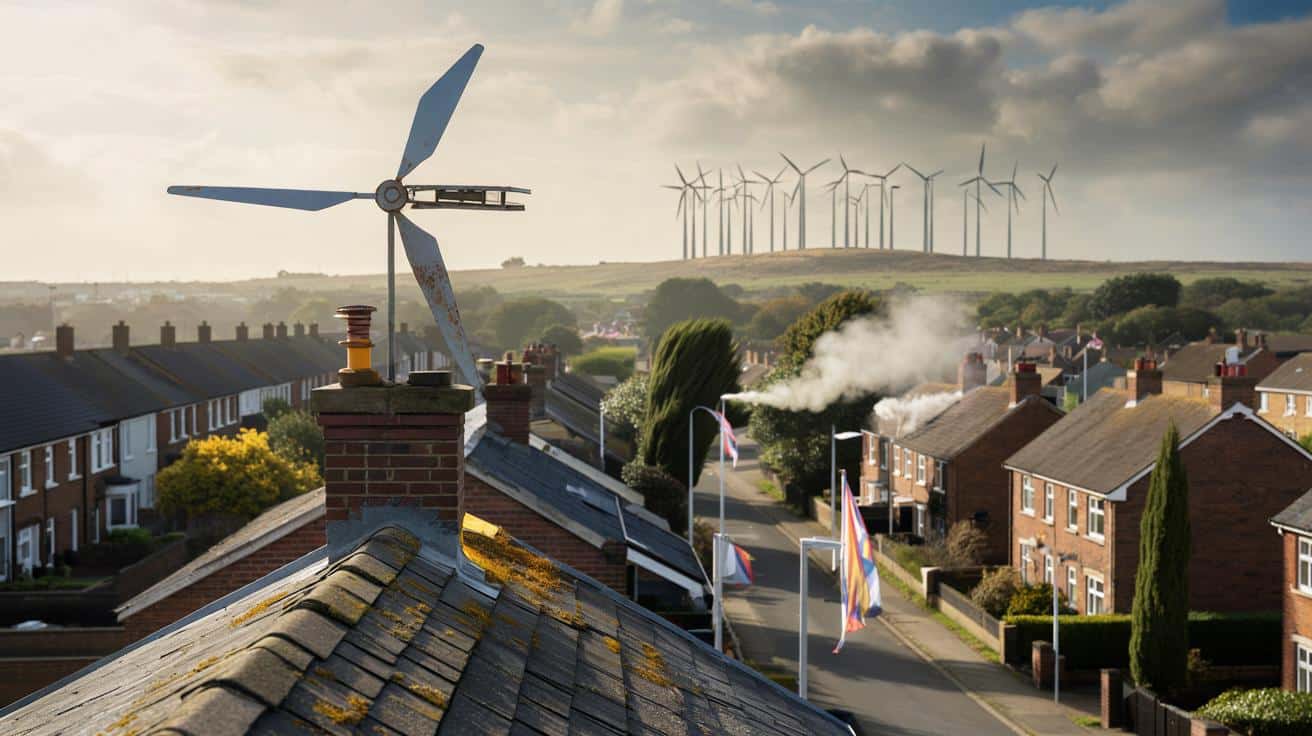
The guy in the hi‑vis jacket stared at his silent wind turbine, bolted proudly to the gable end of his semi-detached house.
The blades twitched, then stopped. The street below was noisy, full of moving air, flapping flags, rattling leaves. Up here, the little turbine barely turned. A few doors down, another one had already been taken down, leaving only rust stains on the bricks. For a technology that promises “free power from the wind”, the reality on ordinary homes often looks oddly still.
He pulled out his phone to check the app. Output: close to zero. Again. The forecast had promised a windy weekend, yet his meter barely moved. The salesman’s brochure was still in a drawer somewhere, with its bold graphs and optimistic payback times. None of those colourful curves had mentioned the phrase that quietly kills most home turbines before they’ve even started: consistent laminar flow.
Why small home wind turbines so often disappoint
Walk through a British housing estate after a few years of “green rush” and you start to notice something. The turbines are either tiny, motionless ornaments or they’re gone altogether. The roofs remain, the satellite dishes stay, but the mini windmills vanish like a fad. People rarely talk about them at the pub. Solar panels, yes. Batteries, yes. Wind? Mostly an awkward shrug.
One homeowner in Yorkshire shared his data online, hoping to inspire others. In the first winter after installation, his 1.5 kW roof turbine produced less than his dishwasher used. A strong storm made it spin like mad for a few hours, then two months of half-hearted wobbling. The charts looked brutal: big spikes, long flat lines. His conclusion was equally brutal – it looked great on the brochure, not on the bill.
The gap between promise and reality comes down to how wind actually behaves around buildings. Turbines love consistent, laminar flow: air that moves in a stable, smooth direction, without violent swirls and sudden holes. Most homes sit in the exact opposite environment. Roof ridges, trees, neighbouring houses and even parked vans break the wind into chaotic turbulence. The turbine senses a gust, starts to respond, then the wind direction shifts sharply and robs the blades of energy. The physics doesn’t care about the marketing copy.
Getting closer to laminar flow at home (without lying to yourself)
The only real way to give a home turbine a fighting chance is to chase smoother wind, not stronger gusts. That usually means height and clean exposure. Mounting a turbine two metres above a cluttered roof rarely works. You need it well above the turbulence bubble that clings to buildings – often 10 metres or more above the nearest obstacle, with clear space in the prevailing wind direction.
On a typical UK plot, that can mean a mast in the garden rather than a gadget on the chimney. It means checking how the wind actually behaves over seasons, not just feeling a draught in November and calling it “a windy spot”. A simple anemometer on a temporary pole, logging a few months of data, tells you more truth than any glossy brochure. *Wind doesn’t just blow, it misbehaves around everything we build.*
On a human level, people usually don’t buy turbines for kilowatt-hours. They buy a story. The story of being off-grid, of “powering my house from my own roof”, of watching the blades turn during a storm and feeling secretly proud. On a blustery day, that story feels real. On a calm week with a stubbornly flat generation graph, it hurts. That’s why so many owners go quiet after the first winter. The tech hasn’t only underperformed; it has embarrassed them a bit.
Engineers will tell you: laminar flow is the quiet hero of every successful turbine project. The big wind farms you see offshore chase it ruthlessly. They choose sites not because the wind is dramatic, but because it’s stable. Blades there see fewer surprises, so they can be tuned for efficiency instead of survival. On a roof in Milton Keynes or Leicester, the poor thing is constantly slapped around by vortices rolling off gables and chimneys. The blades spend much of their life starting, stopping, stalling – like trying to cycle through traffic lights stuck on amber.
How to think like a wind engineer in a terraced street
If you’re tempted by a home turbine, start by acting less like a shopper and more like a weather geek. Spend some time literally watching flags, smoke, tree branches on your street. Notice the gusts that curl back on themselves near corners. Look at how often the wind shifts direction over an hour. Those subtle flicks and swirls are the enemies of laminar flow.
➡️ Visible floor edges enlarge perceived space
➡️ The reason familiar sounds feel grounding during uncertainty
➡️ “White hydrogen” sounds clean and infinite, but geologists say extraction is the real unknown
➡️ The “taxi smell” method: why fabric holds odor and how pros neutralize it
➡️ How “record fish” are verified: what counts as proof beyond a photo and a tape measure
➡️ The centenarian who refuses assisted living: the habit she credits most (and it’s not diet)
➡️ Why some people feel refreshed after routine days
➡️ The subtle difference between feeling busy and feeling mentally engaged
A practical method many professionals use is to map “wind shadows” around a property. Take a rough plan of your house and the neighbours’. Mark trees, sheds, fences, garages. Then draw arrows for the prevailing wind directions over the year. Anywhere the wind has to leap over or squeeze between objects, turbulence will follow. That’s where turbines go to die. The rare decent spots are usually higher than people expect, or further away from the house than the sales pitch suggests.
Soyons honnêtes : personne ne fait vraiment ça tous les jours. Most of us look out of the window, feel a draught on our face and call it “windy enough”. Yet those messy, shifting gusts are exactly why laminar flow rarely appears in suburban gardens. A decent installer will push you to measure, to wait, to gather at least a season of wind data. A bad installer will just tell you it “should be fine” and point at a neighbour’s spinning toy as proof.
“If the wind at hub height changes direction by more than 20 degrees every few seconds, your turbine is spending its life chasing the wind, not harvesting it.” – field note from a UK wind engineer
People who regret their turbines often share the same small list of mistakes. They trusted small roof‑mounts on cluttered houses. They underestimated how much trees grow and spoil airflow. They ignored noise, assuming a small turbine would be silent, then lived with a constant whine at night as the blades fought messy gusts. And they treated average wind speed on a regional map as proof their own plot would perform.
- Check real wind data at your exact height, not just local averages.
- Walk the site in different seasons, not only on one blustery day.
- Question any design that sits close to chimneys, trees or tall neighbours.
- Count maintenance and noise in your “return on investment”, not only kWh.
When the wind doesn’t behave but the idea still matters
There’s a quiet honesty spreading among early adopters who’ve been burned by home turbines. They’re not anti-wind. They’re just pro-reality. Many have shifted to a mix of solar and efficiency upgrades, letting big, well-sited wind farms do the heavy lifting far away, where laminar flow is a real thing, not a marketing phrase. Some have even kept their dead turbines up as a reminder of the lesson.
On a deeper level, the story of failing home turbines is a story about how we relate to technology promises. We want simple objects we can bolt to our lives and feel instantly greener. We resist the boring, slow work of measuring, modelling, waiting for the right conditions. Yet that slow work is exactly where laminar flow hides. It’s not glamorous. It’s just how air moves when nobody has put a wall in its way.
On a windy cliff in Scotland or an open fen in Cambridgeshire, the same 2 kW machine that sulked on a city roof can quietly hum at near‑rated output for hours. The hardware didn’t change. The wind did. That gap – between a blustery feeling and a smooth, consistent flow – is where most home wind dreams fall through. We’ve all had that moment where a gadget promises to “change everything” and ends up in the shed. The trick, with wind, is to learn from the shed before you build the mast.
| Point clé | Détail | Intérêt pour le lecteur |
|---|---|---|
| Laminar vs turbulent flow | Home roofs sit in turbulent, swirling air that kills efficiency | Explains why your turbine idea might underperform before you spend money |
| Site and height matter more than power rating | A modest turbine in smooth wind beats a larger one in messy gusts | Helps you prioritise mast placement and data gathering over brochure numbers |
| Measure first, install later | Simple, months‑long wind logging can reveal if your plot is viable | Reduces risk of costly disappointment and noisy, useless hardware |
FAQ :
- Do small roof-mounted turbines ever make sense in the UK?Rarely. They sometimes work on isolated, exposed buildings with very clean wind and no nearby obstacles, but most suburban and urban roofs sit in highly turbulent air that slashes output and increases wear.
- What is “laminar flow” in simple terms?Laminar flow is wind that moves in a smooth, steady direction, like water flowing evenly in a wide, straight river. Turbines love this, because the blades can spin efficiently without constantly adjusting to chaos.
- How high should a home turbine be to reach smoother wind?Many engineers aim for at least 10 metres above the highest nearby obstacle within about 100 metres. On small plots this often means a tall mast rather than a short bracket on a roof.
- Are there alternatives if my site is too turbulent?Yes. Solar PV, better insulation, heat pumps, and even community wind projects often deliver a better return, both financially and in carbon terms, than forcing a turbine into a bad wind site.
- Can vertical-axis turbines fix the turbulence problem?They cope slightly better with changing wind directions, but they still suffer in strongly turbulent zones and typically have lower efficiency. Without decent laminar flow, they also struggle to deliver the promised energy.