The driver cracks the window, January air knifing in, but the smell doesn’t move.
It’s a mix you know instantly: stale smoke, cheap perfume, spilled takeaway, the ghost of a wet dog from three nights ago. The dashboard is spotless, the seats are wiped down, there’s a little pine tree dangling from the mirror. And yet, the cab still smells… like a cab.
You shift on the seat and realise the odour isn’t floating in the air anymore. It’s living in the fabric. In the foam. In the safety belt that’s brushed against a thousand coats. The driver sprays something sweet at every red light. It only makes the scent more complicated, more layered, like an argument you’re trying to fix with a joke.
By the time you reach your stop, you’re wondering something simple and oddly unsettling.
Where does a smell go when it never really leaves?
The strange logic of “taxi smell”
Spend enough nights in ride-hails or black cabs and you start to recognise that signature “taxi smell”. It isn’t exactly bad. Just dense. Lived-in. A blend of lives passing through one small space, hour after hour. Drivers will tell you they clean every day, crack the windows, hang air fresheners in pairs like lucky charms.
And still, the odour comes back. It clings to your scarf after a long ride, stows away in your hair. The car looks clean, but it doesn’t feel fresh. That’s the unsettling part. You’re sitting on someone else’s yesterday.
On a rainy Friday in Birmingham, I rode with Amir, who’s been driving nights for eleven years. At the lights, he laughed and pointed at the three different fragrance trees on his mirror. “People moan if it smells like food. They moan if it smells like perfume. So I give them… everything.” The car did smell of everything. Kebab. Coffee. Coconut.
He told me his worst shift was during the reopenings after lockdown, when everyone seemed to bring a different scent of stress. One woman doused in heavy musk perfume. A man carrying two bags of curry. A teenager who’d clearly just had a quick cigarette. By 2 a.m., Amir said the smell was so thick he drove with the windows down in near-freezing wind, just to feel like the air was moving.
He wasn’t alone. A small UK survey from a ride-hailing association found that odour complaints spike on Friday and Saturday nights. Yet nearly 70% of drivers in that same poll said they vacuum and spray fragrance daily. The cars look better than many living rooms. The smell, though, tells another story.
The science is quietly ruthless. Odour molecules love soft, porous surfaces. Fabric seats, carpet mats, headliners, seat belts – all of them act like sponges. The molecules aren’t just sitting on top. They slip in, bind to fibres, and hang around long after the actual source has gone. That’s why your coat still smells of last night’s pub, and why one fast-food delivery can haunt a taxi for days.
➡️ Visible floor edges enlarge perceived space
➡️ Home wind turbines fail without consistent laminar flow
➡️ The reason familiar sounds feel grounding during uncertainty
➡️ How “record fish” are verified: what counts as proof beyond a photo and a tape measure
➡️ Beekeeper land tax dispute: the weird definition that turns “helping” into “income”
➡️ The subtle difference between feeling busy and feeling mentally engaged
➡️ “White hydrogen” sounds clean and infinite, but geologists say extraction is the real unknown
➡️ The centenarian who refuses assisted living: the habit she credits most (and it’s not diet)
Air fresheners don’t remove those trapped molecules. They just throw more smell into the room, like shouting over loud music. For a few minutes, your nose is busy with citrus or vanilla, and the brain decides “Ah, clean.” Then the fragrance drops, the base odour seeps back out, and you’re right where you started – only now with a faint hint of fake pine.
How pros actually neutralise “taxi smell”
Professionals talk less about “covering” and more about *breaking up*. The first step is brutally simple: remove the source. That means every crumb of food, every coffee spill, every forgotten takeaway bag under the seat. Dry dirt holds on to smell. Wet stains feed it. So they start with a slow, thorough vacuum, using crevice tools along seat seams and under rails where chips and ash like to hide.
Then comes fabric treatment. Detailers often mix a light, enzyme-based cleaner in a spray bottle and mist it over seats, headliner and carpets, not soaking but lightly dampening. Enzymes help break down organic residues that stink long after they’ve dried. After a gentle scrub with a soft brush, they extract with a wet vac, pulling out both moisture and the dissolved gunk.
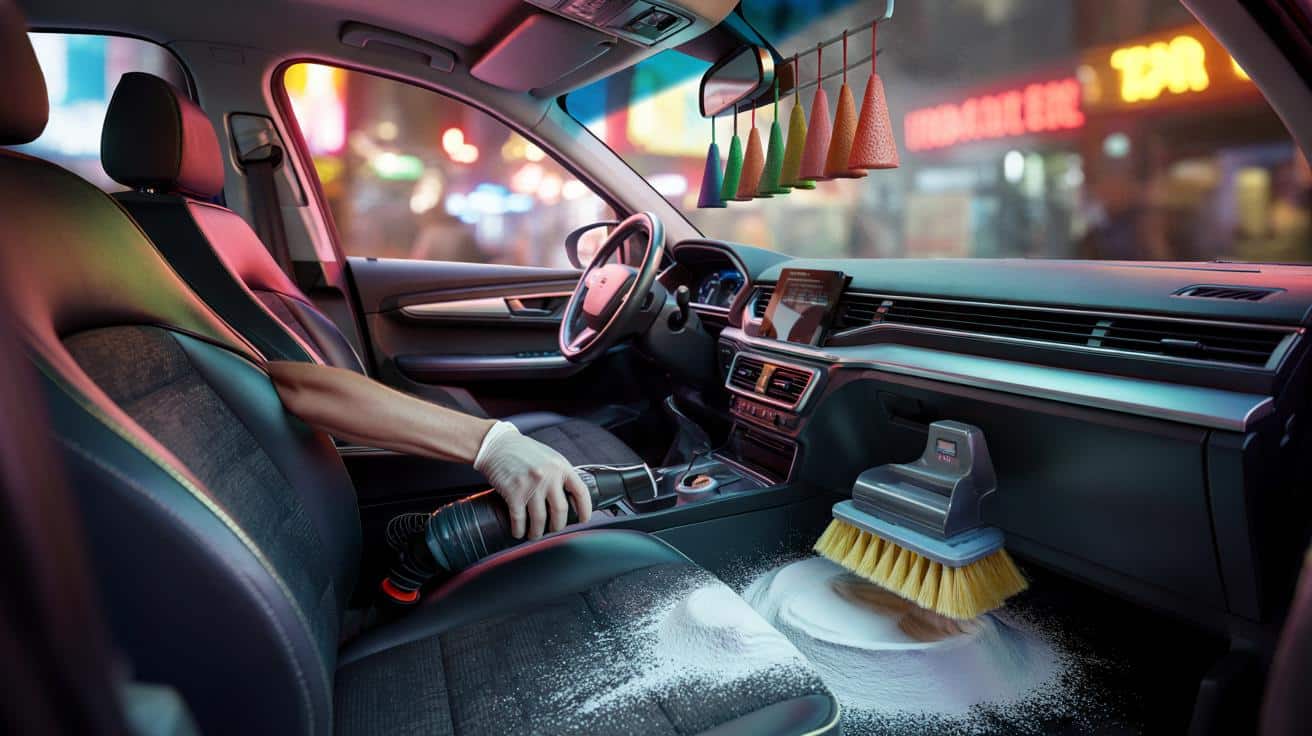
At home, there’s a quieter version of that method. Open all the doors on a dry day. Sprinkle bicarbonate of soda generously over fabric seats and carpets. Leave it there for a few hours, or overnight if you can spare the car. The powder doesn’t mask; it binds some of the odour-causing molecules so they’re easier to remove. Then vacuum slowly, using short overlapping passes, until no white dust is left.
One London-based valeter, Sonia, told me many of her regulars arrive with bootfuls of sprays and gels they’ve tried in desperation. She keeps a box of them in the corner of her workshop as a kind of museum. “New car smell”, “Hawaiian breeze”, “Midnight ice”. She says the real turning point is when people realise their fabric is dirty even if it looks fine. That invisible layer is where yesterday’s takeaway and last month’s cigarette are hiding.
We’ve all had that moment where you open the car door after a long day and get hit by a wall of warm, stale air. Most people blast the AC, crack a window, spray something, and hope for the best. Sonia does the opposite: she airs the car fully first, then treats the surfaces. She’ll focus on touchpoints people forget – seat belts, fabric door inserts, the bit of headliner above the driver’s head. Those areas quietly absorb sweat, hair product and perfume.
She’s kind about it, too. “Life happens in these cars,” she says, shrugging at a coffee stain. “Kids are sick, someone eats in a rush, someone cries after a bad night. It’s not filth. It’s just… life stuck in cloth.” The problem is not that we’re messy monsters; it’s that we underestimate how strongly fabric remembers.
Some pros go even further, using ozone machines or specialised foggers to neutralise trapped odours at a molecular level. It sounds dramatic – and it is. You seal the car, run the machine, let the gas circulate and react with odour molecules in the air and on surfaces. Done badly, it can damage rubber or irritate lungs. Done right, it can strip out years of “taxi smell” in one methodical session.
What surprised me most was how many professionals talk about ventilation as their secret weapon, not perfume. One veteran driver put it bluntly:
“Fresh air is free. Fragrance costs money and usually makes things worse if the car’s dirty.”
So they cycle in outside air rather than recirculating the same cabin air all shift. They crack windows for a minute between passengers. They let the car breathe whenever they’re waiting on a rank. It doesn’t feel glamorous, but it stops odours from building that thick, invisible fog you notice on a Saturday night ride home.
- Use neutralisers, not just scents: products labelled as odour eliminators or enzyme cleaners actually tackle the source.
- Target fabric and foam: seats, belts, headliner and carpets are the real “smell batteries”.
- Think routine, not rescue: light, regular care beats one giant deep-clean after a crisis.
Living with fabric that remembers
Once you see fabric as a kind of memory bank for smell, you start to notice it everywhere. The sofa that still whispers of last winter’s fondue night. The cinema seat that smells faintly of popcorn and other people’s shampoo. The borrowed jacket that carries a stranger’s laundry powder even after you’ve worn it twice.
The “taxi smell” method – the way drivers and valeters battle odour day after day – is really a crash course in how to live with these quiet, clinging memories. It nudges you to think less in terms of panic sprays and more in terms of quiet habits. Crack a window for the last two minutes of your drive. Blot spills the minute they happen. Give fabrics a proper, slow vacuum now and then, not just a rushed once-over with coins still in the cup holder.
There’s also something oddly intimate about it. Smell is the most emotional of our senses, tied straight into memory. A cab can hold a trace of a hen night, a job interview, a late hospital visit. Your own car or sofa carries your story as well as your shopping bags. **Neutralising an odour isn’t erasing a life**, but it is choosing which parts you want to keep in the room with you today.
That’s why professionals are almost philosophical about it. They’re not chasing sterile nothingness; they’re aiming for a kind of breathable neutrality. A space where new memories don’t have to fight through old fumes. And yes, they’ll still pick a scent – a light citrus, a green tea, something that feels like a fresh start instead of a mask.
Soyons honnêtes : personne ne fait vraiment ça tous les jours. Most of us muddle through with whatever spray was on offer at the supermarket and a half-hearted hoover when crumbs become embarrassing. Yet once you’ve ridden in a car that’s been properly neutralised – not perfumed, but truly cleared – it’s hard to un-feel the difference.
| Point clé | Détail | Intérêt pour le lecteur |
|---|---|---|
| Les tissus gardent les odeurs | Fibres et mousses absorbent et retiennent les molécules d’odeur bien après la disparition de la source | Comprendre pourquoi le “taxi smell” revient toujours et pourquoi le simple spray ne suffit pas |
| Nettoyer avant de parfumer | Éliminer miettes, taches et résidus, puis utiliser enzymes, bicarbonate ou extraction pour neutraliser | Disposer d’un protocole simple inspiré des pros pour assainir voiture ou canapé |
| Aération et routine | Renouveler l’air, traiter régulièrement les tissus plutôt que d’attendre la catastrophe olfactive | Garder un intérieur plus sain, plus léger, sans collections de désodorisants inefficaces |
FAQ :
- Why does my car still smell even after using air freshener?Because the molecules causing the odour are stuck in fabric and foam, the spray only covers them temporarily instead of removing them.
- Does bicarbonate of soda really work on “taxi smell”?Yes, it can bind some odour molecules in seats and carpets; leave it for a few hours, then vacuum thoroughly to see a noticeable improvement.
- Are leather seats better for avoiding bad smells?Leather and vinyl absorb less than cloth, but seams, foam underneath and carpets can still trap strong odours like smoke or food.
- How often should I deep-clean my car interior?For everyday use, two or three good fabric cleanings a year, plus light monthly care, is usually enough to prevent stubborn odours.
- Do professional ozone treatments really remove smells?They can be very effective at neutralising persistent odours, but they should be done carefully and ideally by someone who knows how to use the equipment safely.