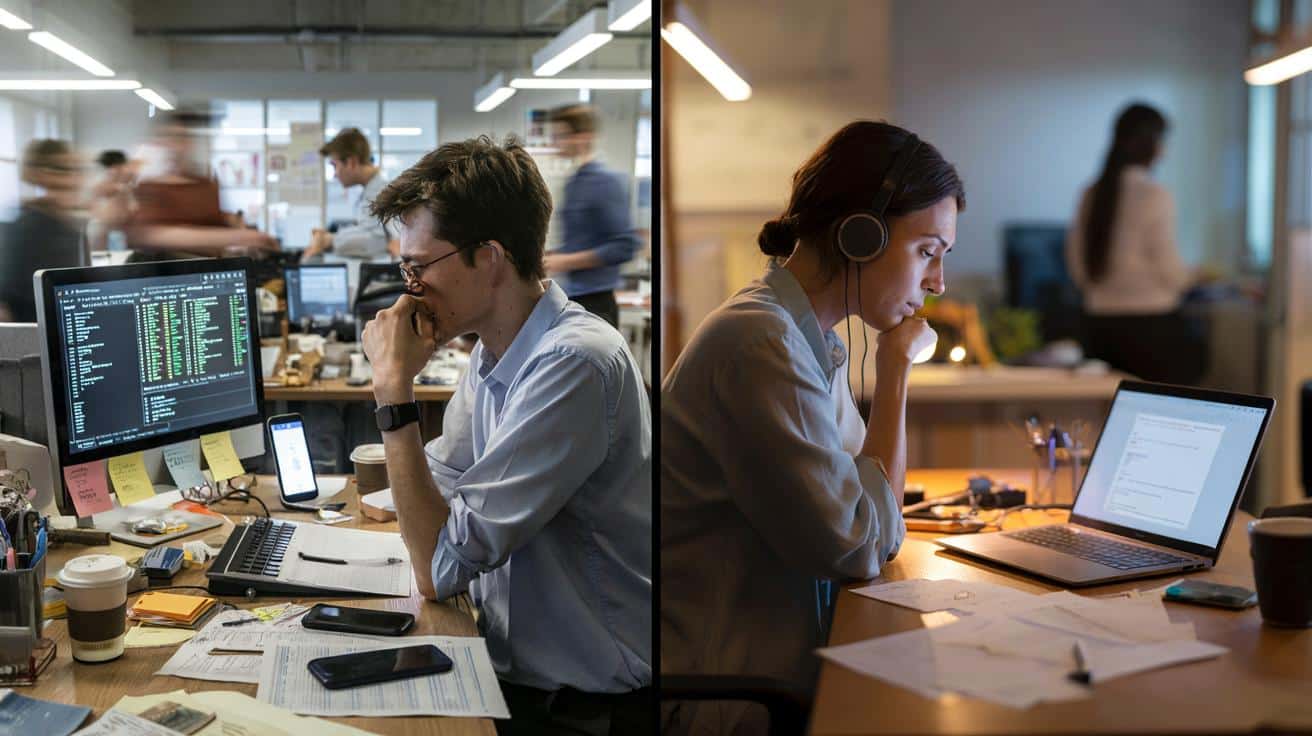
The office looked productive on paper.
Screens glowing, calendars full, Slack pinging like a fire alarm. Yet if you watched a bit longer, you saw the small tells: the glazed eyes, the tab-hopping, the constant checking of phones under the desk. Lots of motion, very little spark.
One woman in marketing stared at a spreadsheet for 20 minutes, fingers frozen above the keyboard. Her to‑do list was long, coloured, beautifully organised. But she hadn’t touched the task that actually mattered to her career. She went home that night exhausted, wired, and weirdly empty.
She wasn’t lazy. She was busy. And not engaged.
The next morning, on the same floor, a developer worked quietly on a tricky feature. No flashy multitasking, no heroic late-night emails. Just deep, steady focus. At 4 pm, she leaned back, smiled to herself, and shut her laptop with a calm you don’t often see. The difference between those two days is so small you can miss it.
The thin line between noise and real engagement
There’s a particular flavour of tired that comes from a day packed with calls, emails and “quick favours” — and still leaves you wondering what you actually did. Your brain feels like a browser with 47 tabs open, each one auto‑playing a different song. That’s the texture of being busy: full, loud, but strangely hollow.
Feeling mentally engaged is almost the opposite sensation. Time bends a little. Your shoulders drop instead of climbing toward your ears. You know exactly what you’re doing and why. The task might be hard, but there’s a crispness to it, like cold air in your lungs on a winter morning. You finish tired, yes, but it’s the good kind.
That difference is subtle on the outside. Inside, it changes everything.
Think about your last “back-to-back meetings” day. The one where your calendar looked like a Tetris game gone wrong. You jumped from video call to video call, answered messages in the five minutes in between, ate something vaguely sandwich-shaped at your desk, and dealt with three “urgent” requests before 11 am.
By early afternoon, your brain felt like it was wading through wet cement. You were reacting, not choosing. Then maybe, at 4:30 pm, you opened a document you’d been meaning to write for a week. For 40 minutes, you were in it. No notifications, no side chats. You lost track of time, hit save, and finally felt like you’d done some actual work.
Same office, same job, same person. Two totally different mental states, separated by a line you don’t always notice you’re crossing.
➡️ Why some people feel refreshed after routine days
➡️ “White hydrogen” sounds clean and infinite, but geologists say extraction is the real unknown
➡️ Beekeeper land tax dispute: the weird definition that turns “helping” into “income”
➡️ Visible floor edges enlarge perceived space
➡️ Home wind turbines fail without consistent laminar flow
➡️ The centenarian who refuses assisted living: the habit she credits most (and it’s not diet)
➡️ How “record fish” are verified: what counts as proof beyond a photo and a tape measure
➡️ The reason familiar sounds feel grounding during uncertainty
What’s happening is deceptively simple. Being busy overloads your short-term attention with small, disjointed tasks. Your brain stays in “switch mode”, hopping between shallow problems, never dropping into the deeper gears where meaningful thinking lives. Engagement is the opposite: your mind locks onto one clear problem, with a clear goal, and enough time to wrestle with it.
One state is dominated by external demands — the pings, the meetings, the “have you got five minutes?”. The other is anchored in internal drive — curiosity, mastery, or just the quiet satisfaction of finishing something real. *Our bodies don’t always tell the difference: both leave you tired. But only one builds something lasting inside you.*
That’s why so many people confuse the two and live in a permanent state of busyness, while secretly starving for engagement.
How to move from “always on” to genuinely engaged
One small but powerful move is this: define a “core hour” in your day. Just one. Sixty minutes where your only job is to be mentally engaged with one meaningful task. No multitasking, no sneaky inbox checks “just in case”, no “quick scroll” to reward yourself halfway through.
Pick your task before the hour starts. Give it a clear finish line: write the first page, solve three problems, outline the proposal, review the key numbers. Then remove as many distractions as you can, even if it feels over the top — phone in another room, notifications off, door closed or headphones in. During that hour, your priority is depth, not volume.
You can go back to being “busy” afterwards. But you’ll carry something different out of that hour.
The main trap is turning this into yet another self-optimisation ritual you’ll abandon in four days. Soyons honnêtes : personne ne fait vraiment ça tous les jours. Life happens. Kids get sick, clients call at the worst moment, the train is late, the boiler explodes.
So treat your core hour like a practice, not a rule. If you miss it, you haven’t failed, you’ve just postponed it. Many people also pick tasks that are too big — “finish my book”, “plan the whole quarter” — and then feel crushed before they start. Shrink your goals until they feel slightly too easy.
And be kind to yourself when your attention fights back. Engagement isn’t a switch; it’s more like a muscle you haven’t used properly in years.
“Feeling busy is your brain shouting, ‘Look how much I’m doing!’ Feeling engaged is your brain quietly saying, ‘This matters.’”
- Signal physique : Busy often feels jittery; engagement feels steady.
- Test rapide : Ask yourself, “If I repeated this day 100 times, would I be proud of the result?”
- Micro-changement : Swap one 30‑minute “fake work” slot for one 30‑minute focused block.
These are tiny levers, but they start to tilt your day away from noise and towards depth. **Your brain quietly notices the difference, even if your calendar doesn’t.**
Letting your days tell a different story
The subtle gap between “I was so busy” and “I was really into it” is where a lot of our modern restlessness lives. You can fill years with back-to-back activity and still feel strangely underused, like a musician paid to carry instruments but never play. Engagement is what turns time spent into time inhabited.
On a random Tuesday, this might look like moving one meeting, saying no to one fake-urgent request, and giving yourself half an hour to wrestle with a problem you actually care about. Nobody else will see the shift. There’s no badge for it, no app that claps for you. Yet your internal weather changes, slowly.
On a wider scale, this is about deciding what kind of tired you want at the end of your day. The heavy, numb tired of endless context switching. Or the softer, cleaner tired of having stretched your mind on something that mattered, even briefly. We don’t always get to choose our workload or our boss or our family schedule. We do get a say in those small pockets of engagement that, over time, quietly rewrite who we feel we are.
| Point clé | Détail | Intérêt pour le lecteur |
|---|---|---|
| Busy vs engaged | Busy is reactive and fragmented; engagement is focused and purposeful. | Aide à mettre un mot précis sur un malaise diffus. |
| Core hour | Une heure par jour dédiée à un seul travail significatif, sans distractions. | Propose un geste concret, réaliste, pour retrouver de la profondeur. |
| Qualité de la fatigue | Observer la différence entre fatigue vide et fatigue satisfaisante. | Permet de réajuster son quotidien sans tout changer d’un coup. |
FAQ :
- How do I know if I’m just busy or truly engaged?Notice how you feel at the end of the task: do you feel wired and empty, or tired but quietly satisfied? If time flew and you can clearly say what you moved forward, that’s engagement.
- Can I feel engaged doing tasks I don’t like?Yes, if the task has a clear purpose or leads to something that matters to you. Break it into small, winnable chunks and focus on finishing one chunk with full attention.
- What if my job is mostly meetings and emails?Look for the hidden “real work” inside that: decisions, relationships, problem-solving. Try to give even 20 minutes of undivided attention to one meaningful piece each day.
- Does engagement always mean deep, creative work?Not necessarily. You can be engaged washing dishes, fixing code, or answering support tickets, as long as your mind is present and you see the point of what you’re doing.
- How can I start if my attention span feels broken?Begin embarrassingly small: 10–15 minutes of focused work, phone away, one clear goal. Increase slowly. **Consistency beats intensity** for rebuilding mental stamina.